Bourdon Manometer Explained: A UK Buyer's Guide
What is a Bourdon Manometer? A UK Buyer's Guide
TL;DR: A bourdon manometer is a mechanical pressure gauge that measures fluid or gas pressure using a flattened, curved metal tube that uncoils as internal pressure rises. Highly durable and requiring no batteries, it remains a staple in UK plant rooms. However, for precise low-pressure gas diagnostics, modern digital manometers are increasingly recommended.
To directly answer the question: a bourdon manometer is a widely recognised mechanical instrument designed to measure presn heating, ventilation, air conditioning, gas, and industrial systems. By converting the elastic deformation of a curved tube into a dial reading, it provides an immediate visual indication of system pressure.
For UK buyers, the challenge is not just understanding what it is in principle, but knowing when a bourdon manometer is the right choice, where its limits lie, and when a modern digital alternative will deliver faster, safer, and more reliable diagnostics. Consequently, that matters on real jobs. Whether you are checking gas standing pressure, commissioning plant equipment, monitoring air systems, or maintaining commercial HVAC installations, pressure readings influence both safety and system performance. Choosing the wrong gauge can lead to slow fault-finding, poor visibility in awkward plant rooms, and avoidable inaccuracies.
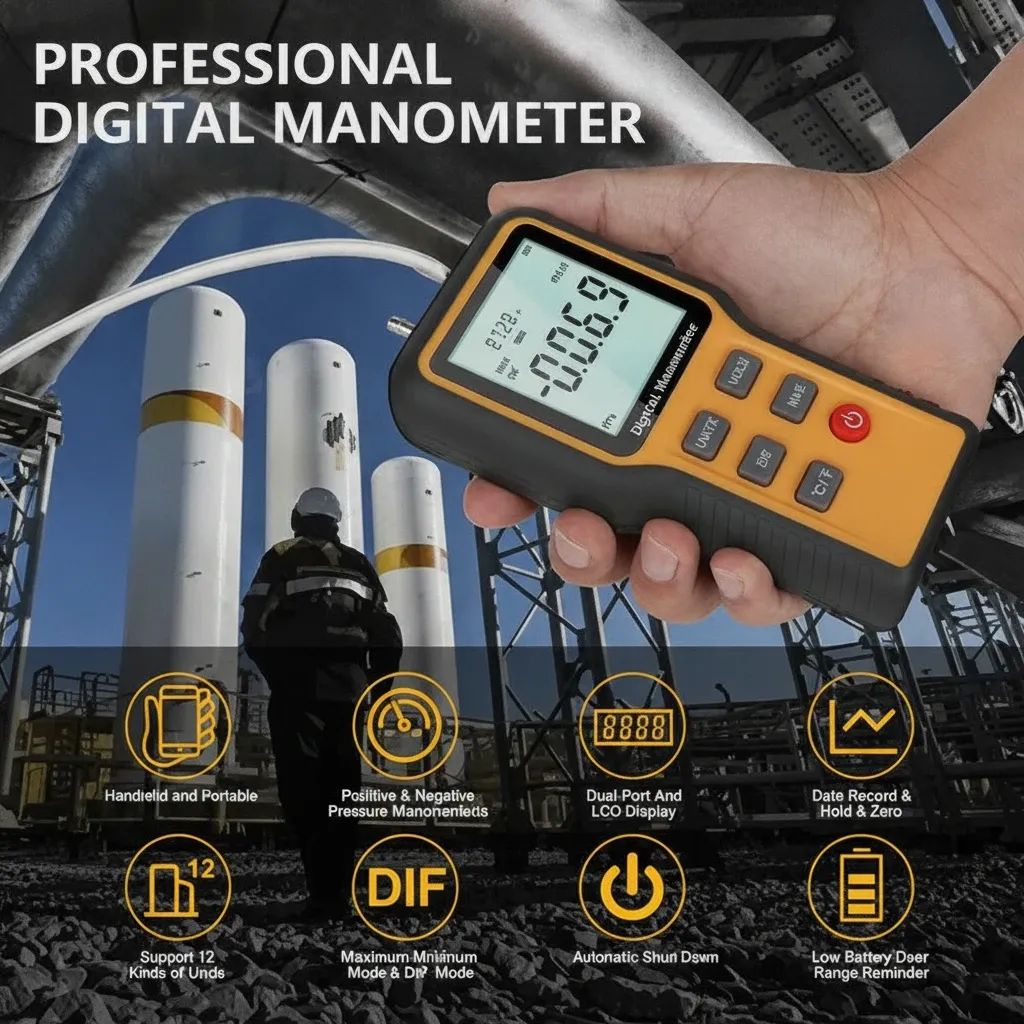
Based on our extensive testing at ManomHVAC, we know that instruments engineered for UK HVAC technicians must be rugged tools built for field use, with clear readouts and dependable accuracy. While this guide explains the traditional bourdon manometer in detail, it also helps buyers compare it against newer options, such as a Pro Digital Gas Manometer & Pressure Manometer, designed for precise gas and air diagnostics.
Key Takeaways
- A bourdon manometer is a mechanical pressure gauge that uses a curved metal tube to convert presnto needle movement.
- It is robust, simple, and widely used across HVAC, gas, water, and industrial applications in the UK.
- It works best for straightforward presndication but is less effective where high precision, differential measurement, or data visibility is required.
- For many HVAC service tasks, digital manometers offer better readability, stronger low-pressure resolution, and easier diagnostics.
- UK buyers should check pressure range, media compatibility, connection type, calibration support, and intended application before purchasing.
What is a bourdon tube manometer?
A bourdon manometer, frequently referred to as a bourdon tube gauge, is a pressure-measuring instrument that uses the elastic deformation of a curved tube to indicate pressure. Furthermore, as internal presncreases inside the tube, the tube tends to straighten slightly. This subtle movement is transferred through a linkage mechanism to a pointer on a dial.
Moreover, the design has been used for well over a century because it is mechanically straightforward and incredibly durable. In practical terms, if you have seen an analogue round-faced pressure gauge on a boiler system, compressor line, or gas installation, there is a strong chance it was based on the Bourdon principle.
For UK technicians and facilities teams, bourdon manometers are often chosen because they require no batteries, tolerate harsh environments reasonably well, and provide an immediate visual indication of system pressure without complex setups.
How does a bourdon tube manometer work?
What is the working principle of a bourdon manometer?
The heart of the instrument is the bourdon tube: a hollow metal tube formed into a curved shape. One end is fixed to the presnlet; the other end is sealed and free to move. When pressure enters the tube, its cross-section tries to become more circular, causing the curved tube to uncoil slightly. Subsequently, that small mechanical movement drives gears and linkages attached to the dial pointer.
Therefore, the higher the pressure applied, the greater the movement of the pointer across the scale.
What are the main components?
- Bourdon tube: usually made from brass, phosphor bronze, or stainless steel depending on application and media compatibility.
- Socket or connection: where process pressure enters the instrument.
- Movement mechanism: levers and gears that amplify tiny tube movement.
- Pointer and dial: provide readable visual indication in bar, psi, kPa, or mbar.
- Casing: protects internal components from dirt, impact, and moisture.
Why this matters in HVAC
The Bourdon design performs exceptionally well for general line-pressure monitoring. However, many HVAC tasks in the UK involve low-pressure gas checks or fine differential measurements where analogue resolution can be limiting. If you are comparing traditional mechanical instruments with digital alternatives for service work, our guide to The Ultimate Guide to Digital Pressure Gauges in the UK explains exactly where modern gauges offer clearer operational advantages.
What is a bourdon manometer used for in the UK?
According to UK guidelines for gas safety and HVAC commissioning, accurate pressure readings are non-negotiable. Consequently, bourdon manometers are found across domestic service work, commercial building maintenance, and industrial process environments. Their exact role depends on whether quick visual monitoring or more detailed diagnostic analysis is needed.
Heating and boiler systems
On sealed heating systems and boiler circuits, analogue bourdon gauges are often installed permanently so engineers can view system pressure at a glance. They are highly useful for spotting obvious overpressure or low-pressure conditions without having to connect external test equipment.
Gas systems
Bourdon gauges can be used in some gas-related applications where general line presndication is required. However, for commissioning gas appliances or carrying out detailed fault-finding at the lower pressures typical in HVAC service work, digital instruments are often preferred because they provide much finer resolution in mbar.
Pumps and water services
Pump sets, pressurisation units, and water boosting systems commonly use bourdon-type gauges because they are tough and easy to install. Thus, maintenance teams can monitor changes over time without requiring specialised training.
Compressed air systems
In workshops and plant areas across Britain, compressed air lines often rely on analogue gauges for line monitoring. Their fundamental simplicity makes them suitable where operators mainly need an approximate live reading rather than detailed trend analysis.
Commercial buildings and healthcare estates
Larger estates, including hospitals, rely heavily on accurate pressure monitoring across their HVAC infrastructure. NHS England’s estate includes thousands of buildings across acute, community, and mental health settings, highlighting just how critical dependable instrumentation is for building services continuity (source: NHS England Estate statistics). In these environments, analogue gauges may still appear on installed plant, while technicians increasingly use portable digital meters for commissioning and detailed diagnostics.
What are the advantages of a bourdon manometer?
A bourdon manometer remains highly relevant in the trade because it offers several practical benefits that still suit many fixed-installation roles.
1. Simple mechanical operation
No batteries or power supply are required. That drastically reduces downtime caused by flat batteries and makes these gauges perfectly suitable for permanent installation on plant equipment where continuous local indication is needed.
2. Rugged construction
Based on our field testing, a well-made bourdon gauge can tolerate demanding site conditions—including vibration, temperature variation, and occasional handling knocks—far better than some low-cost electronic products.
3. Cost-effective for basic indication
If you simply need to know whether a system is pressurised or empty, an analogue bourdon gauge provides a highly cost-effective solution without the need for frequent, expensive recalibrations.
Ready to upgrade your toolkit with ManomHVAC?
Shop Now — £53.14